

Ipsative vs. Normative Assessments: What HR Teams Need to Know
When your organization invests in pre-employment assessments, the goal is straightforward: get reliable, comparable data that helps you hire the right person for the job. But not all assessments produce data that supports that goal equally well.
The difference often comes down to a single methodological choice: ipsative vs. normative. It sounds like an academic distinction, but it has direct consequences for whether your assessment data is actually fit for selection decisions.
In This Article
Why Assessment Methodology Matters for Hiring
Pre-employment assessments have become a mainstream part of hiring. According to the SHRM 2024 Talent Trends Report, 54 percent of organizations now use them to evaluate applicants’ knowledge, skills, and abilities — and 78 percent of those organizations say assessments have improved the quality of their hires. But those outcomes depend on the data the assessment produces, and that starts with the underlying methodology.
The ipsative vs. normative question applies specifically to personality and behavioral assessments. Aptitude and cognitive ability tests are normative by design: there are right answers, and every score reflects how a candidate performs relative to others. With personality, where no answer is objectively correct, test designers face a genuine choice between two approaches. That choice shapes everything about how the results can be used.
What Is a Normative Assessment?
How Normative Scoring Works
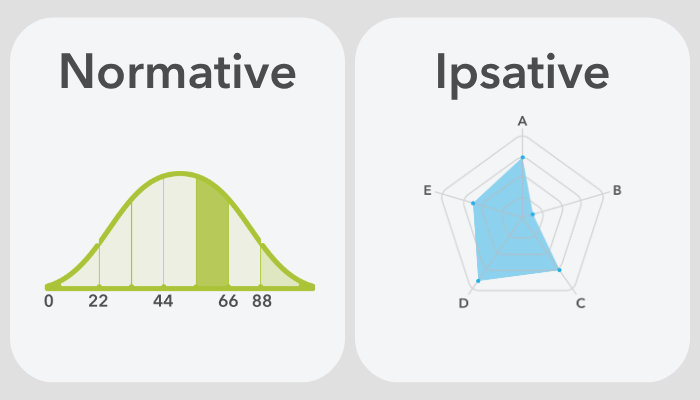
A normative assessment measures a candidate’s traits or abilities against a standardized reference group, typically a broad population of working adults. The result is a score that tells you not just what someone answered, but how their response compares to everyone else who has taken the same assessment.
That external reference point is what makes normative data so useful for hiring. When two candidates complete a normative personality assessment, their scores can be directly and meaningfully compared. You know whether someone scores high or low on a given trait relative to a consistent benchmark, not just relative to the other applicants in your current pipeline.
What Normative Questions Look Like
Normative assessments typically present questions with a range of response options, allowing candidates to express degrees of agreement or disagreement rather than forcing a binary choice. This design produces richer, more granular data, and makes the results more stable across different test-taking sessions.
What Is an Ipsative Assessment?
How Ipsative Scoring Works
An ipsative assessment works differently. Instead of comparing a candidate to an external population, it measures the relative balance of traits within that individual. Candidates are typically asked to choose between two or more options, ranking or selecting which one applies most or least to them.
The British Psychological Society (BPS) describes ipsative tests this way: they compare the balance of characteristics within a given individual and can identify someone’s strongest personality characteristic, but they cannot say anything about how that person stacks up against someone else on those characteristics.
That last part is the key limitation. Because ipsative results are self-referential, they cannot be objectively compared across candidates. You can learn which traits are dominant relative to someone’s other traits, but not how one candidate measures against another, or against a role benchmark.
Common Ipsative Formats in Practice
Many ipsative assessments use forced-choice question formats, requiring candidates to pick between two extremes. In practice, most people fall somewhere in between on most traits. Forcing a choice between being extremely introverted or extremely extroverted, for example, produces a response that reflects the constraint of the question as much as the actual trait being measured. DISC and Myers-Briggs use this format, and both explicitly state in their technical documentation that their tools are not intended for use in employee selection.
Not every ipsative tool relies on forced choice. The Predictive Index Behavioral Assessment uses a free-choice adjective format, which gives it ipsative characteristics: it focuses on behavioral patterns rather than independently normed trait scores, reporting a four-factor behavioral pattern that is interpreted through reference profiles. Importantly, PI still supports candidate comparison through those reference profiles and its job-target matching process.
Ipsative vs. Normative: Why the Difference Matters for Hiring Decisions
This is not a debate about which format is more pleasant to complete. It is a question of what the data can reliably tell you.
Hiring decisions require comparison. You are evaluating multiple candidates for the same role, often across different stages of a process and sometimes across multiple hiring managers. The integrity of that comparison depends entirely on whether your assessment data gives you a consistent, stable reference point.
Normative assessments are designed to provide exactly that. Every candidate’s score is measured against the same population baseline, so your evaluations are grounded in something objective. You can build job benchmarks that reflect the traits associated with high performance in a specific role.
With ipsative assessments, you lose that external reference point. Since the data reflects only the individual, it can tell you how someone’s traits rank relative to each other, not how that person compares to other candidates or to the role you’re hiring for. For hiring decisions, that distinction is the difference between data you can act on and data you can only discuss.
Dr. Paul Kline, one of the leading authorities on psychometric testing, put it plainly in his Handbook of Psychological Testing, calling normative tests “far superior to ipsative tests as precise measures of psychological characteristics.” In his view, ipsative scores are suitable only as a basis for discussion, and since normative tests can serve that purpose too while also producing statistically usable scores, there is little reason to choose an ipsative format.
The Research Behind Normative Personality Assessment
The Big Five personality framework that underpins normative assessments like Prevue’s has one of the strongest evidence bases in applied psychology. A 2022 quantitative synthesis published in the Journal of Personality analyzed results across 54 meta-analyses, covering more than 550,000 participants, and found consistent associations between Big Five traits and performance outcomes.
Conscientiousness showed the strongest relationship with job performance across studies. Findings like these are why normative assessments built on the Big Five can serve as a reliable input into hiring decisions, particularly when paired with role-specific benchmarks.
Are Ipsative Assessments Legally Defensible for Hiring?
The methodology question also carries compliance implications. For a hiring assessment to be legally defensible, it must measure job-related skills and traits in a way that is valid, reliable, and applied consistently across candidates. As SHRM explains, assessments used in selection should have predictive validity, meaning they measure competencies directly relevant to the role being filled.
Ipsative tools that measure only relative orientations within an individual, rather than standardized, comparable trait scores, have a harder time meeting that bar. When assessment results cannot be consistently compared across candidates, it becomes difficult to demonstrate that the tool is being applied in a structured, job-related way.
When to Use Ipsative Assessments
Ipsative assessments are not without value. They have a legitimate role in employee developmental contexts, where the goal is to help an individual understand their own strengths and growth areas rather than comparing them to others. Common examples include coaching conversations, career development programs, and self-reflection exercises.
The issue arises when ipsative tools are used for candidate selection and screening, a fundamentally different purpose. When you need to rank candidates, assess job fit against a benchmark, or make a defensible hiring decision, you need data that holds up to comparison. Ipsative scores were not designed to do that.
What to Look for When Evaluating Pre-Employment Assessments
When evaluating assessment tools, methodology should be part of your due diligence. SHRM recommends that employers confirm an assessment has been validated for its intended purpose, that reliability and validity studies are available, and that it measures knowledge, skills, and abilities relevant to the role.
In practice, that means asking:
- Is this assessment normative or ipsative?
- Can the scores be compared across candidates and against a job benchmark?
- Is there published validity research showing the tool predicts job performance?
- Is the methodology documented and defensible if a hiring decision is ever challenged?
Prevue Assessments are built on normative methodology. Scores reflect where a candidate stands relative to a population baseline, and role-specific benchmarks show how the results translate to job fit. Together, that gives hiring teams a consistent, evidence-based foundation for comparison and more confident decisions.

Ipsative vs. Normative: Choose the Right Tool for the Job
Methodology might not be the first thing on your assessment checklist, but it should be. The ability to compare candidates against a consistent standard is what turns assessment data into better hiring decisions.
Want to see how Prevue’s normative assessments work in practice? Explore the Prevue Assessment Suite or book a demo with our team.