

Evolving the Prevue Culture Assessment: A More Flexible, Precise Approach to Culture Fit

Good assessment science doesn’t stand still. As organizations grow, as candidate expectations shift, and as psychometric methods advance, the tools we use to measure culture fit should keep pace. The updated Prevue Culture Assessment reflects this kind of intentional evolution, driven by real-world feedback, rigorous research, and a commitment to improving both the science and the experience.
In This Article
What Clients Were Telling Us
As adoption of the Culture Assessment grew, a consistent theme emerged from client feedback: the forced-choice format, while effective, felt constraining.
In the original model, respondents evaluated organizational values in groups of 10, selecting three that most represented their culture, three that least represented it, and leaving four unselected. This structure had genuine psychometric strengths: it encouraged prioritization, reduced social desirability bias, and created meaningful differentiation between values.
But the limitation was structural. Because selections were made within fixed groupings rather than across all 40 values, organizations couldn’t always configure their culture profile to reflect reality. A company might find two highly important values clustered in one group and four in another, with no way to accurately represent that distribution. Clients wanted the ability to prioritize across the full value set, with more nuance and fewer constraints.
Designing a Better Experience
Addressing this feedback required more than a technical fix. It called for a rethinking of the assessment experience itself. Collaboration across the product, psychometric, and customer success teams led to a structured evaluation of both the usability and psychometric implications of a redesigned format.
To test proposed changes before committing, the team conducted focus groups with assessment participants. The findings were clear: the updated format was described as smoother, more intuitive, and more visually engaging. Participants used words like “interactive” and “gamified,” a signal that the redesign had meaningfully improved the experience without sacrificing substance.
This mattered. Research consistently shows that candidate experience affects completion quality and perception of the hiring organization. Improving how an assessment feels is not separate from improving its scientific value; the two are linked.
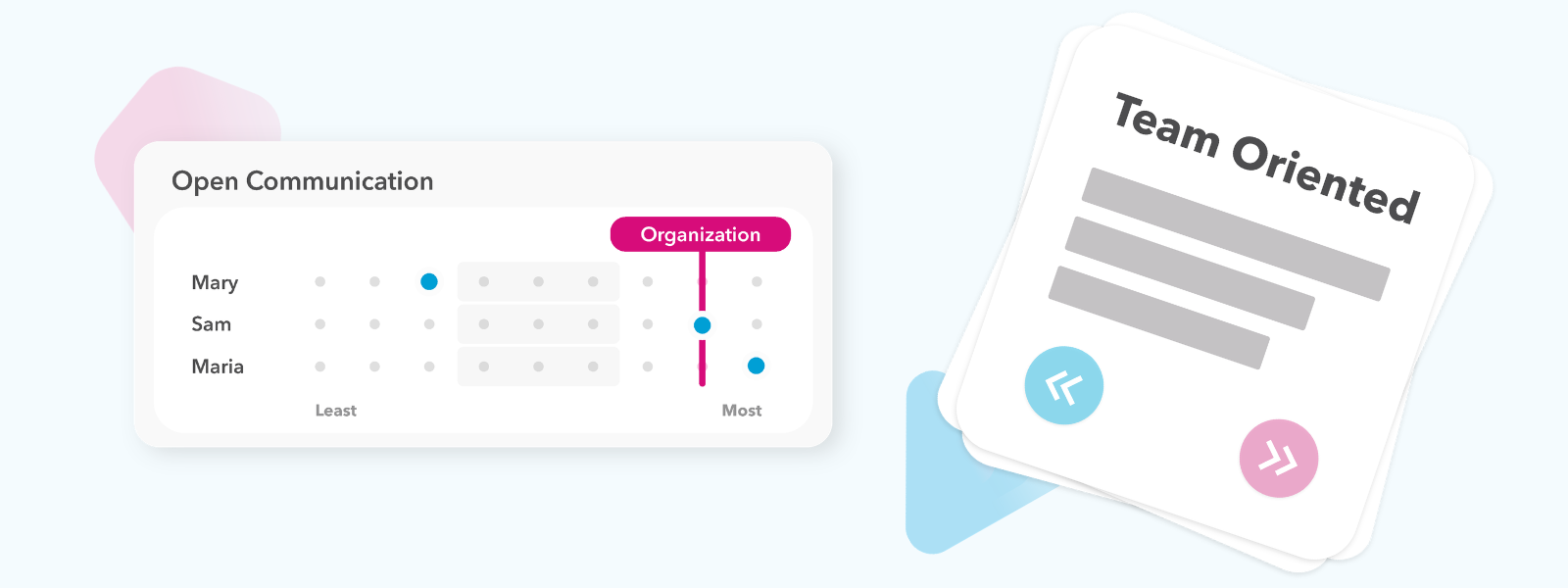
The Updated Format: A Q-Sort Style 9-Point Scale
The core of the assessment remains unchanged: the same 40 organizational values, the same culture-fit purpose, the same commitment to psychometric rigor. What changed is how respondents interact with those values.
The updated model transitions from the forced-choice grouping format to a Q-sort style 9-point scale. Rather than evaluating values within fixed sets of 10, organizations now assess all 40 values across a continuous scale, allowing them to assign equal weight where appropriate, differentiate more precisely where it matters, and build a culture profile that reflects genuine organizational complexity.
This approach preserves what made the original format effective: it still discourages rating everything uniformly and still creates meaningful differentiation. But it does so with greater flexibility and without the constraints of fixed groupings.
Strengthening Scoring Precision
The updated format also improves the underlying measurement model. By expanding the response scale and enabling comparisons across all 40 values simultaneously, the assessment produces richer, more granular culture profiles. This translates directly into more refined culture-fit comparisons, giving organizations a clearer picture of candidate alignment with their defined culture.
To be precise: the previous model was scientifically sound. This update builds on a strong foundation rather than replacing it. The goal was never to reinvent the assessment, but to extend its precision and flexibility in ways that better serve the organizations and candidates using it.
The Takeaway
The best assessment improvements don’t come from chasing novelty. They come from listening carefully, testing thoughtfully, and evolving with intention. The updated Prevue Culture Assessment is more flexible, more precise, and more engaging to complete. Most importantly, it was shaped directly by the people using it.
That’s what good assessment science looks like in practice.
This article was written by Baila Glogauer, M.S., I/O Psychologist.