

Prevue vs Predictive Index: Which Hiring Assessment Solution is Right for Your Team?
Choosing a pre-employment assessment platform is rarely just a features comparison. It’s about understanding what kind of hiring insight your team needs, how that data fits into your process, and whether the platform is built to support the way your team actually works.
Both Prevue and Predictive Index (PI) help organizations evaluate candidates beyond the resume. But they take meaningfully different approaches to assessment, job fit, and implementation. Those differences matter depending on what your team is trying to accomplish.
In This Article
Prevue vs Predictive Index at a Glance
Predictive Index is a talent optimization platform with a broad scope, combining behavioral insights and cognitive assessments with tools for team performance, leadership development, and workforce alignment. Its behavioral assessment uses a free-choice adjective format with ipsative characteristics, reporting a four-factor behavioral pattern interpreted through reference profiles rather than independently normed trait scores. Its focus extends well beyond the hiring decision, making it a fit for enterprise organizations that want a single platform across multiple stages of the employee lifecycle.
Prevue is purpose-built around the hiring process, with normative, science-backed assessments covering aptitude, personality, and motivations, custom job benchmarking, and dedicated support designed for internal HR teams. Where PI leans into post-hire strategy, Prevue’s core focus is helping organizations make better, more confident hiring decisions from the start, with post-hire analytics available for teams that need that visibility too.
Where Prevue Stands Out
Personality Assessment Grounded in the Big Five
Prevue’s Personality Assessment is based on the Big Five, also known as the Five-Factor Model, which is one of the most extensively researched and validated frameworks in organizational psychology. But the framework itself is only part of the story.
Prevue’s implementation is normative, meaning candidate scores are measured against a general population baseline rather than only against other applicants in your pipeline. This gives hiring teams a stable, external reference point for every result, making comparisons more objective across roles, teams, and hiring cycles. For a deeper look at how normative scoring works and why it matters, see our guide on normative vs. ipsative assessments.
The assessment measures 13 definable traits across dimensions including independence, conscientiousness, extraversion, emotional stability, and social desirability, giving hiring teams structured, consistent insight into how a candidate is likely to behave and perform at work.
A Complete View of Candidate Potential
Strong hiring decisions are rarely made on a single data point. Prevue’s Assessment Suite combines aptitude, personality, and motivations into one cohesive candidate view, helping teams understand how quickly someone learns, how they prefer to work, and what keeps them engaged over time.
That complete picture feeds directly into Prevue’s Job-Fit Report, which compares each candidate’s results against a benchmark built around the specific requirements of the role. Job fit looks beyond surface-level qualifications to assess whether a candidate’s abilities, personality, and motivations align with what the role demands and the environment they’d be working in. The Job Suitability Score gives hiring teams a clear, quantifiable read on how closely each candidate aligns with the role.
Custom Benchmarks Built Around Real Job Fit
Every role has different success factors. Prevue’s custom benchmarks define what the ideal candidate looks like for a specific position, built around the traits, abilities, and motivations that matter most for that role. Prevue’s process is self-serve, meaning internal HR teams can build, manage, and refine benchmarks directly using job description surveys, top performer studies, and a standard benchmark library, without needing outside help to get it right.
Fast Implementation, Ongoing Support
Prevue is built to get hiring teams up and running quickly. The platform has a short learning curve by design, and every customer is paired with a dedicated Customer Success Manager who guides teams through implementation, benchmark setup, and report interpretation from the start.
That ongoing support means internal HR teams can start making assessment-backed hiring decisions without a lengthy onboarding process or dependence on external consultants. For growing organizations that want expert guidance while maintaining ownership of their hiring process, it’s a meaningful advantage from day one.
Where Predictive Index Stands Out
Strong and Established Brand
PI has a well-established presence in the talent assessment market, particularly among enterprise organizations. Backed by over 70 years of science and more than 42 million assessments administered globally, PI has a documented history of use across hiring, leadership development, and workforce planning. For organizations already familiar with the platform, that familiarity can carry real internal momentum.
A Simple, Low-Friction Behavioral Assessment
The PI Behavioral Assessment uses a free-choice adjective checklist where participants select words that describe how others expect them to behave and how they see themselves. The format has ipsative characteristics, meaning it focuses on behavioral patterns rather than independently normed trait scores. Results are expressed as a four-factor behavioral profile and interpreted through PI’s reference profiles and job-target matching process, which still allows for candidate comparison within PI’s framework.
For teams that prioritize a low-friction candidate experience, the brevity of the assessment is a genuine advantage. However, because the format does not produce norm-referenced scores tied to a general population baseline, it works differently than a fully normative assessment when it comes to direct inter-individual comparisons across roles and hiring cycles.
A Platform Built Beyond Hiring
Predictive Index has evolved its platform with a strong focus on post-hire people strategy. While it includes hiring tools, much of PI’s value proposition centers on what happens after the offer is signed, including team performance, leadership development, and workforce alignment. For organizations looking for a platform that spans the full employee lifecycle, that broader scope may be appealing. For teams whose primary need is improving the quality and consistency of hiring decisions, it is worth considering whether a platform built around post-hire outcomes is the right starting point.
Consultative Support Model
PI is typically delivered through a network of certified partners and structured implementation programs. Getting fully up and running with PI often involves working through a certification process, including a multi-day workshop series that covers the platform’s methodology, tools, and application across hiring and talent strategy. For organizations with the time and resources to invest in that process, it can provide a strong foundation for company-wide adoption.
A Note on Assessment Methodology
When evaluating these two platforms, the underlying methodology matters more than most teams realize.
Prevue’s Big Five-based personality assessment is fully normative, meaning each of the 13 personality traits is independently scored and measured against a general population baseline. This produces norm-referenced scores that can be used for direct inter-individual comparisons across candidates, roles, and hiring cycles. PI’s Behavioral Assessment uses a free-choice adjective format with ipsative characteristics, reporting a four-factor behavioral pattern interpreted through reference profiles and job-target matching rather than independently normed trait scores. Candidate comparison is still possible within PI’s framework, but the methodology differs meaningfully from a normative approach
That distinction carries through to benchmarking as well. Prevue’s benchmarks are built through a validated, self-serve process internal teams can manage directly. PI’s job targeting is typically manager-defined or requires consultant involvement, which can add friction for teams that want to own the process internally.
For hiring teams, the key question isn’t which assessment is faster to complete. It’s whether the methodology behind it produces data your team can confidently own, compare, and act on when it matters most.
Which Hiring Assessment Solution Is The Better Fit?
To make the differences easier to evaluate, here is a side-by-side look at what each provider offers across assessments, hiring tools, and support.
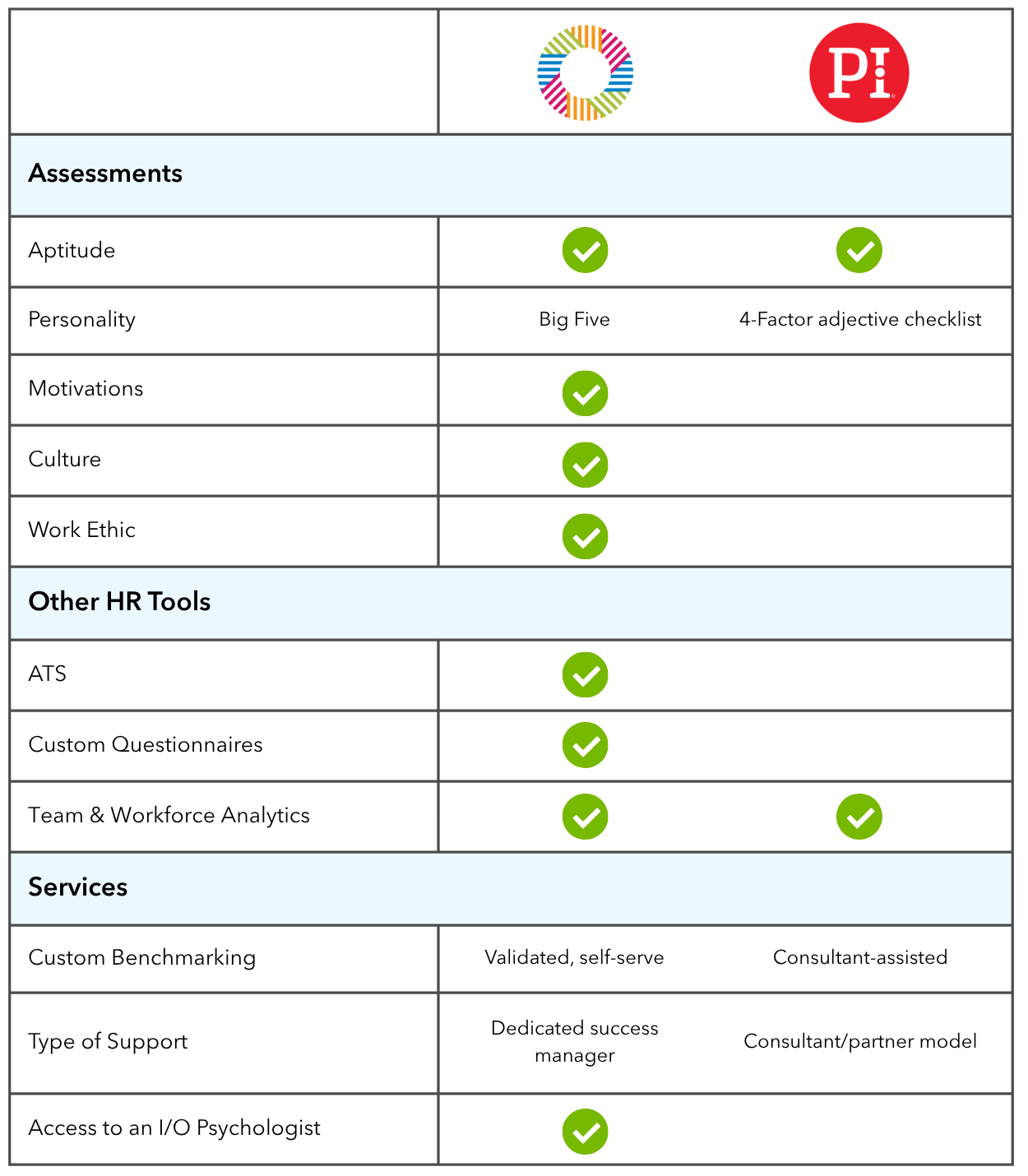
The table above reflects a meaningful difference in platform focus. Predictive Index is primarily geared toward post-hire talent strategy, with behavioral insights that extend into team performance, leadership development, and workforce alignment. Prevue is built with pre-hire at the core, combining normative assessments, custom benchmarking, and dedicated support to help internal HR teams make confident hiring decisions, while also offering team and workforce analytics for organizations that need post-hire insight too.
Which Hiring Assessment Solution Is Right for Your Team?
Predictive Index is well-suited for organizations that want a platform centered on post-hire people strategy and are comfortable working within a consultant-supported model to get there.
Prevue is built for organizations that want to make better hiring decisions first. With normative, science-backed assessments, custom job benchmarking, and dedicated Customer Success support, internal HR teams can implement and own their hiring process directly, without consultant overhead or complex setup. And for teams that need visibility beyond the hire, Prevue’s team and workforce analytics provide post-hire insight without requiring a separate platform.
To see how customers compare the two side by side, visit Prevue vs Predictive Index comparison page or check us out on G2.
You don’t need more hiring tools. You need the right ones. Prevue gives hiring teams the insight to improve hiring and retention without adding unnecessary complexity.

Frequently Asked Questions
What is the main difference between Prevue and Predictive Index?
Prevue’s Personality Assessment is based on the Big Five (Five-Factor Model), measuring 13 independent personality traits against a general population baseline. Each trait is norm-referenced, meaning scores can be compared directly to a normative working population and to a role-specific benchmark. PI’s Behavioral Assessment uses a free-choice adjective format with ipsative characteristics, reporting a four-factor behavioral pattern interpreted through reference profiles rather than independently normed trait scores. While PI’s approach still supports candidate comparison through its job-target matching process, Prevue’s fully normative scoring allows for more direct inter-individual comparisons across candidates and roles.
What is the difference between a normative and ipsative assessment?
A normative assessment measures a candidate’s traits against a general population baseline, producing independently scored results that can be compared directly across candidates, roles, and hiring cycles. An assessment with ipsative characteristics, like PI’s free-choice adjective format, focuses on behavioral patterns relative to the candidate’s own responses rather than against an external population reference point. Prevue’s personality assessment is fully normative, with norm-referenced scores tied to a general working population that support direct inter-individual comparisons. PI’s Behavioral Assessment reports a four-factor behavioral pattern interpreted through reference profiles and job-target matching. For a deeper look at how the two approaches differ, see our guide on normative vs. ipsative assessments.
What is a Job Suitability Score and how does it work?
Prevue’s Job Suitability Score is a quantifiable measure of how closely a candidate’s aptitude, personality, and motivations align with the benchmark built for a specific role. It gives hiring teams a consistent, evidence-based reference point for comparing candidates and prioritizing top talent, without relying on gut instinct alone.
How does Prevue’s personality assessment differ from the PI Behavioral Assessment?
Prevue’s Personality Assessment is based on the Big Five (Five-Factor Model), a widely validated framework in organizational psychology that measures 13 defined traits against a general population baseline. PI’s Behavioral Assessment uses a free-choice adjective checklist to surface behavioral drives based on self-perception. Normative assessments like Prevue’s are designed to produce more structured, comparable data across candidates and roles.
Which platform is better for internal HR teams that want to own their hiring process?
Prevue is built with internal HR teams in mind. Its self-serve benchmarking, Job-Fit Reports, and dedicated Customer Success support give teams the tools and guidance they need to implement and manage their hiring process directly, without requiring external consultants or a lengthy certification program.
Does Predictive Index include a motivations or culture assessment?
No. PI’s assessment suite is primarily focused on cognitive aptitude and behavioral drives. Prevue includes assessments for motivations, culture fit, and work ethic alongside aptitude and personality, giving hiring teams a broader view of candidate fit.
Can Prevue integrate with our existing ATS?
Yes. Prevue offers a native ATS as well as integrations with a range of third-party applicant tracking systems, making it flexible for teams that want to build assessments into their existing hiring workflow.